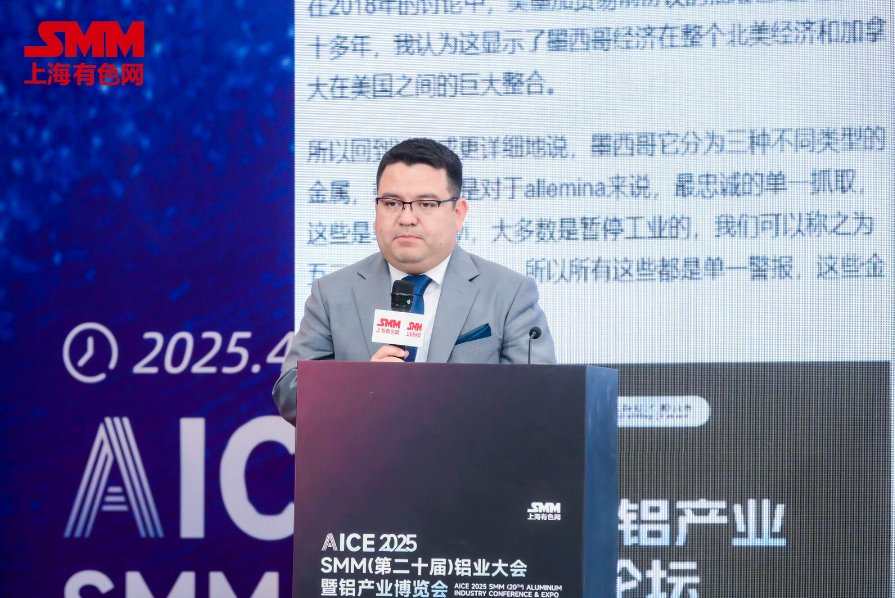
On April 18th, at the AICE 2025 SMM (20th) Aluminum Industry Conference & Aluminum Industry Expo - Global Secondary Aluminum Industry Development Forum, hosted by SMM Information & Technology Co., Ltd. (SMM), SMM Metal Exchange Center, and Shandong Aisi Information Technology Co., Ltd., and co-organized by Zhongyifeng Jinyi (Suzhou) Technology Co., Ltd. and Lezhi County Qianrun Investment Promotion Service Co., Ltd., WENCESLAO MANZANO HERNANDEZ, President of DIMEXA HOLDINGS PTE. LTD., provided an interpretation of Mexico's export policies for secondary metals.
Mexico: A Key Trading Partner
Mexico is a crucial participant in the global economy, with a Gross Domestic Product (GDP) of $1.79 trillion, making it the world's 12th largest economy. In 2024, Mexico's total trade volume with the US reached $843 billion, becoming the largest trading partner of the US, surpassing Canada and China. In the same year, Mexico's total trade volume with China reached $100 billion. Mexico has the largest number of free trade agreements, with 13 agreements covering at least 50 countries.
Main Products Exported by Mexico
Automobiles and automotive parts, electronics and electrical equipment, machinery and industrial equipment, mineral fuels and oil, and agricultural products, among others.
US-Mexico Trade Relations
In 2018, the US imposed tariffs under "Section 232" on steel (with a 25% tariff) and aluminum (with a 10% tariff) imported from multiple countries, including Mexico.
・This raised concerns about damage to the integrated supply chain, particularly in the automotive industry.
・In 2019, the US agreed to remove the "Section 232" tariffs on steel and aluminum imported from Mexico and Canada.
・Part of the purpose of this decision was to facilitate the ratification of the United States-Mexico-Canada Agreement (USMCA).
Aluminum Scrap Market
・Mexico exports aluminum scrap to multiple destinations worldwide.
・Single-alloy scrap is mainly exported to the US, Brazil, and Europe. For example, scrap of grades 5052, 6,016, 5,081, 3003, etc.
・Most casting alloys are consumed within Mexico's domestic automotive industry, with only a small amount exported. For example, casting alloys of grades A380, AC12, etc.
・Some other mixed-grade aluminum scrap is exported to Asia. For example, Taint Tabor, aluminum radiators.
Copper Scrap Market
・China is by far the largest consumer of copper scrap.
・There is also domestic demand in the US for some higher-grade copper scrap.
・Mexico does not import copper scrap from the US; if copper scrap is imported from the US to Mexico, a 16% VAT is required.
Opportunities for Mexico in the Non-Ferrous Metals Market
・Production Growth and Rising Demand. Mexico's expanding manufacturing sector (automotive, electronics) drives production and demand for recycled non-ferrous metals.
・Proximity to the US: Close trade ties with the US facilitate scrap metal trade.
・Increased Recycling Awareness: Growing concerns over environmental issues drive recycling efforts.
・Investment in Advanced Recycling Technologies: In Mexico, there is a growing demand and opportunity to invest in modern technologies for sorting, processing, and refining non-ferrous metal scrap.
・Development of Specialized Recycling Processes: With the growth of industries such as electronics and renewable energy in Mexico, there are opportunities to develop specialized recycling processes for specific non-ferrous metals. For example, recycling of batteries and electronic waste.
Challenges for Mexico in the Non-Ferrous Metals Market
・Market Volatility: Similar to global commodities, prices of non-ferrous metals can be volatile, affecting profitability. The Mexican market is guided by the London Metal Exchange but is also influenced by the Chicago Metal Exchange and Midwest Premium in the US.
・Logistics and Infrastructure: Mexico's domestic infrastructure varies, and there are logistical bottlenecks that complicate the collection, processing, and transportation of scrap.
・Regulatory Issues: Evolving or unclear regulations regarding scrap handling, import/export, and environmental compliance can create uncertainty and increase operational costs.
・Quality and Sorting: Ensuring scrap quality and proper sorting is challenging, especially in finding qualified labor.
・Competition: The market may face competition from both domestic and overseas participants, including established recycling companies and the informal sector.
・Economic Uncertainty: Mexico's overall economic conditions, including currency fluctuations and potential economic slowdowns, may affect demand and investment in the industry.
・Safety Concerns: In some regions, safety issues and organized crime may pose risks to companies involved in the collection and transportation of valuable non-ferrous metals.
Importance of Establishing Partnerships
・Navigating Regulations and Bureaucracy: Mexico's regulatory environment is complex. Local partners are often more familiar with the rules, licensing requirements, and procedures, which can help streamline business operations and ensure compliance.
• Establishing a Local Network: Building partnerships can provide connections to existing networks of suppliers, buyers, and other industry participants. This is crucial for sourcing scrap, selling processed metals, and establishing solid business relationships.
DIMEXA
Dimexa is a leading company in Mexico specializing in the management of industrial and post-consumer non-ferrous metal scrap. With 40 years of experience in the market, Dimexa currently sells 300,000 mt of non-ferrous metal scrap annually.
• Scrap Metal Management: Dimexa offers comprehensive services, including the collection, processing, and sale of scrap.
• National Presence: Dimexa operates 17 scrap recycling yards across Mexico.
• Logistics Capabilities: Dimexa has a large fleet of vehicles and containers for efficient collection and delivery of materials. It currently handles an average of 1,000 containers per month.
• Focus on Compliance: The company emphasizes adherence to environmental regulations and holds all necessary permits to operate across Mexico.
• Market Reach: Dimexa has over 35 years of experience selling to the Chinese market and other international markets.
![Cost Side Diverges and Weakens, Aluminum Fluoride Lacks Support and Remains Slightly Under Pressure [SMM Analysis]](https://imgqn.smm.cn/usercenter/PerRJ20251217171650.jpg)